Just a lil nitpick: article is by iFixit who is a Lenovo business partner. So perhaps less objective than one might hope.
It seems to me that Lenovo’s repairably is more affected by that iFixit partnership than the opposite. I don’t see anything factually wrong or suspicious in the article.
Nevertheless, a conflict of interests is possible.
I agree, but like others have said, it bodes well that they’re open about this in the article
Lenovo also owns the Motorola phone brand, and they’re going to adopt/allow GrapheneOS. I think they know how to grab customers right now, and I honestly like it.
Isnt lenovo the company that used to make the rugged military laptops that actually had Chinese or foreign backdoors installed?
Edit: for those interested https://www.investigativeeconomics.org/p/government-still-buying-lenovo-laptops
Edit 2 from a quick search. Lenovo laptops have faced allegations of containing backdoor vulnerabilities that could allow unauthorized access to data, particularly concerning military use. These concerns have led to bans on Lenovo products by various intelligence agencies due to potential cybersecurity risks.
 securityaffairs.com Wikipedia
Lenovo Laptops and Backdoor Concerns
Background on Lenovo’s Security Issues
Lenovo, a Chinese technology company, has faced multiple allegations regarding security vulnerabilities in its laptops. These concerns primarily revolve around potential backdoors that could allow unauthorized access to sensitive data.
Notable Incidents
Year Incident Description 2008 U.S. military investigators reported finding backdoored chips in Lenovo motherboards, which allegedly logged keystrokes and transmitted data.
2013Intelligence agencies in the U.S., UK, and Australia banned Lenovo PCs due to backdoor vulnerabilities discovered during testing.
2015The Federal Trade Commission (FTC) charged Lenovo for pre-installing adware that created security vulnerabilities, leading to a settlement.
2016The Pentagon warned that Lenovo computers could introduce compromised hardware into the Defense Department.
That’s fucking depressing and SO ironic…
So in order to get more spying machines onto US IT networks, their honey pot is “build a product that is pro consumer”, and it will sell like hotcakes in the IT community.
What a fucking timeline
The shitty aspect is their actually not bad hardware. They last forever and seem to be held in high regards in the tech community but it’s as if people forgot a decade later than their still owned by Chinese. Still banned for security reasons for military use even currently after 20 years. Now the military still supplies them just not for mission critical purposes but for personal devices not govt use.
Wild. Every tech person at some point shills for Lenovo and they do have great things. Just screams Trojan horse to me still. IMO
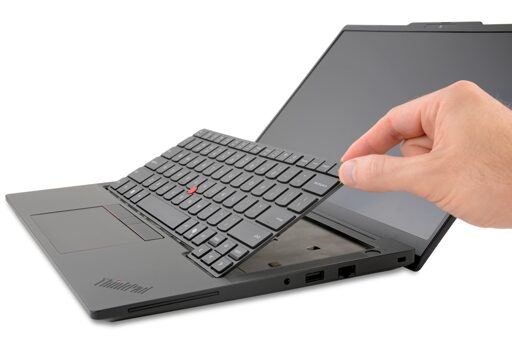
That’s nice you can replace the charging port without reflowing the motherboard now.
There’s a difference between ‘repairable’ and ‘upgradable.’ Most of the comments seem to conflate the two. Lenovo isn’t doing a Framework.
It’s a smart move. Differentiates them from other laptop-makers for corporate IT, who can do the parts swaps themselves. Also smart is associating the brand with iFixit and working to get a 10/10. That’ll be what sets them apart from all the others, at least for the next year or two.
The “upgradability” part in a small laptop is questionable to me, anyway.
The GPU is really compromised in that chassis, as having it in a slot compromises cooling big time, and limits how much power it can use. And while I love upgradable RAM for the CPU… it’d be better if they used faster CAMM modules. Many other brands have upgradable SSDs/WiFi.
Swappable ports are awesome, no question.
…But honestly, I’d rather have a smaller chassis, bigger GPU and better cooling right off the bat, like a Zephyrus chassis. And have it reparable, and make the whole motherboard standardized/swappable, but not compromise the chassis so severely by making it modular.
A think pad t series is not really much harder to take apart than a framework. Just more screws and fewer magnets. The screen is probably an exception however.
That’s his point. It’s similar to framework, but not the same.
Easy repairability is great, truly.
But framework offers more than that, easy repairability AND upgradability, because they offer new upgraded parts with the same compatibility as the old ones, so you can just drop them in.
Lenovo is not yet doing that. Which is fine. Just a noteworthy difference.
I would be curious to see how often people actually upgrade their frameworks.
I agree with their repair stance. It just feels like one of those things people will tell you they want and then never do.
Still maybe the explosion in memory prices will change the incentives and people will start holding things longer. It will be interesting to see.
Nice to see this pop up as Apple announce their 5yr plan to flood the world’s landfills & scrap yards with 8gb fused ram Neo’s.
Hasn’t Apple been soldering everything to the motherboard for ages now?
Oh yeah…for well over a decade. If you’re REALLY lucky the proprietary form factor m.2 is user replaceable and not just sad bits soldered direct to the PCB. (Edit: I really really hate Autoassume, that’s supposed to be “SSD bits”… I’ll leave it as is because it’s funny)
My wife has a 2017 MacBook Air, at some point in the last few years it stopped getting system and security updates. She didn’t notice until she got a pop-up from Chrome saying that her OS is no longer supported. Completely ignored it until around October last year when some websites stopped working and gave an error indicating out of date certificates.
(There’s a lot in those last 3 sentences that is wildly troubling to me…)
Took me from October until mid-January to convince her to TRY Linux. So I went to buy her a new m.2…and paid an extra £20 on top of standard because of the proprietary form factor. Luckily I bought before the major price hikes…got a 256gb m(ac).2 for ~£90. Would have just backed up her files and wiped the original drive but she wanted to be able to switch back to her exact installation if she didn’t like Linux…and the new drive is double the capacity 👍
I wonder if this will shut up the “they don’t make them like they used to” crowd.
Edit: i knew that wouldn’t be the case. It didn’t need this thread as proof.
Well they dont lol, they are super flimsy these days and most stuff is soldered on. Its good if this turns out to be the start of the return to good thinkpads, but i wouldnt get my hopes up yet.
What exactly is soldered on that shouldn’t be? If you want a processor that’s user replaceable, you should just get a PC. If RAM, SSD and the ports are user replaceable, that sounds pretty good to me.
Why should it be?
Have you ever carried a laptop on actual travel? Like sprinting across a train station to catch your connection? You’ll definitely learn to appreciate a smaller lighter laptop.
That’s what the T14s is for, no?