But sure, if you are wondering how folks out in Yemen or Gaza managed to retaliate against their oppressors for so long, this is a textbook example of how and why. What’s being proposed is collection of technology we’ve had since at least the 1960s that’s slowly made its way into civilian circulation.
Also…
Khojayev’s just-launched prototype has no effectiveness track record
I mean, we’re seeing what “just-launched prototypes with no effective track record” have accomplished on the Ukraine-Russia front-lines and it’s a decidedly mixed bag.
I think a harder question to answer is “Who would be interested in putting one of these into practical use?” And that gets to the real value-add of a Stinger MANPAD. Namely, the humans willing and practiced enough to use it.
Also - and again, this cannot be overstated - the model above has no explosives installed. Idk how confident I’d be around one of these things if it was actually armed.
Not my area of expertise, so please tell me if the idea is complete garbage. With that being said: Theoretically, could the LiPo Battery that’s already in there anyway be turned into an explosive payload by intentionally overheating and puncturing it on impact?
Not my area of expertise, so please tell me if the idea is complete garbage.
Turning a laptop battery into a weapon is a non-trivial endeavor. The absurdity of TSA was more their attempt to police based on weak science than the real danger of an airplane full of lithium battery powered devices.
Not really an answer to you, just writing it here in case anyone else interested is still reading along:
I looked up some numbers and apart from the practical challenges of making a battery “go boom” in a controlled way it seems like the energy density to even make this a hypothetical option just isn’t there. Even the best LiPo batteries don’t quite reach 1 MJ/kg while gunpowder has ~3 MJ/kg, and numbers only go up from there for more modern chemical explosives.
Certainly possible. But you’re still stuck on the r2 problem of diminishing returns at a distance. Light doesn’t like staying in a tight beam. The vortex loop is typically not much bigger than the wavelength. I don’t see much of a solution for transmitting energy long distances through air.
I synthesize energetics. I can make a primary explosive that is stable enough for cap usage with a solo cup. I can synthesize secondaries like RDX above (one of the more complicated common ones) in short order with a basic chemistry set and the internet to order basic reagents. None are controlled substances.
It is trivially easy to make effective shapes charges and energetics at home.
Synthesis is federally legal in the US so long as you do not assemble into a device or transport. You can do both with an SOT as an FFL.
If I wanted to, I could make a shaped charge that was point imitated and base detonated for the above projectile and it would punch through about 1.5 feet of homogeneously rolled steel.
The limit to threat is not the access to explosives, as the chemistry and processes are published freely online as easy to replicate. The drone parts and control surface actuation is by far harder and I say this as someone who has a professional background in computer science and software engineering.
It is trivially easy to make effective shapes charges and energetics at home.
Safely?
If I wanted to, I could
You’ve got enough information to try to execute the above formula. Okay. And you’ve still got all your fingers after attempting this… more than zero times?
The drone parts and control surface actuation is by far harder and I say this as someone who has a professional background in computer science and software engineering.
Absolutely. We invented gunpowder centuries before we invented airplanes.
That said… as an anecdote, I had a friend who had a janitorial position. Cleaning a particularly stubborn toilet and dumped a bunch of bleach into the bowl. His coworker came in behind him and proceeded to piss in said boil, creating a toxic miasma that forced them to exit the restroom quickly and heavily ventilate it before returning.
“I could cook up some blasting caps with the trash from a frat party” is a theoretically believable claim.
“Every time I clean up a frat party, I add a dozen shaped charges to my inventory” is not.
Keep the reaction stirring under ice and if you see the temp rise above 15 C you dump the whole thing in a water bucket or you get a runaway exothermic reaction that is never good with a high explosive forming crystals in the solution.
If you are stupid, don’t ventilate, or are stupid stupid it will light your shed on fire and potentially kill you.
That’s why you work at lab scale, and why you always keep your reactions under the temp limits with acids added slowly.
Basic chemistry safety covers all the bases here.
My preferred blasting caps are nickel guanidine based. I can play with the crystal morphology to produce small more friction inert powder and it is an extremely simple synthesis.
You can use reloading press combined with highly suggested lexan sheet as a blast shield and wooden block to gently press the powder into caps. China sells packs of 1000 electrical ignition assemblies for $40 that you can then set off with a COTS or a clacker.
I cannot emphasize enough that working at small scale and knowing what you are doing are important, but in faster time than it takes to print the parts for that drone you can absolutely complete the reaction, do some recrystalizstion, dry your product,and be ready to mix with plasticizer.


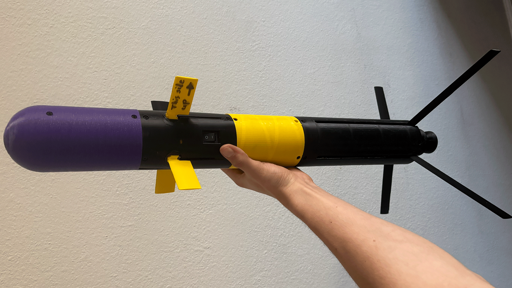
Notably absent… the explosives.
But sure, if you are wondering how folks out in Yemen or Gaza managed to retaliate against their oppressors for so long, this is a textbook example of how and why. What’s being proposed is collection of technology we’ve had since at least the 1960s that’s slowly made its way into civilian circulation.
Also…
I mean, we’re seeing what “just-launched prototypes with no effective track record” have accomplished on the Ukraine-Russia front-lines and it’s a decidedly mixed bag.
I think a harder question to answer is “Who would be interested in putting one of these into practical use?” And that gets to the real value-add of a Stinger MANPAD. Namely, the humans willing and practiced enough to use it.
Also - and again, this cannot be overstated - the model above has no explosives installed. Idk how confident I’d be around one of these things if it was actually armed.
Anyone know what the $2 propellant is?
https://en.wikipedia.org/wiki/Rocket_candy
Thanks!
That doesn’t seem to fit in the budget though??
https://xkcd.com/651/
Not my area of expertise, so please tell me if the idea is complete garbage. With that being said: Theoretically, could the LiPo Battery that’s already in there anyway be turned into an explosive payload by intentionally overheating and puncturing it on impact?
Turning a laptop battery into a weapon is a non-trivial endeavor. The absurdity of TSA was more their attempt to police based on weak science than the real danger of an airplane full of lithium battery powered devices.
Not really an answer to you, just writing it here in case anyone else interested is still reading along:
I looked up some numbers and apart from the practical challenges of making a battery “go boom” in a controlled way it seems like the energy density to even make this a hypothetical option just isn’t there. Even the best LiPo batteries don’t quite reach 1 MJ/kg while gunpowder has ~3 MJ/kg, and numbers only go up from there for more modern chemical explosives.
I have this idea: Scientists some time ago, discovered they could knot light into loops.
Would it be possible to make a curved laser for laser artillery?
Certainly possible. But you’re still stuck on the r2 problem of diminishing returns at a distance. Light doesn’t like staying in a tight beam. The vortex loop is typically not much bigger than the wavelength. I don’t see much of a solution for transmitting energy long distances through air.
I synthesize energetics. I can make a primary explosive that is stable enough for cap usage with a solo cup. I can synthesize secondaries like RDX above (one of the more complicated common ones) in short order with a basic chemistry set and the internet to order basic reagents. None are controlled substances.
It is trivially easy to make effective shapes charges and energetics at home.
Synthesis is federally legal in the US so long as you do not assemble into a device or transport. You can do both with an SOT as an FFL.
If I wanted to, I could make a shaped charge that was point imitated and base detonated for the above projectile and it would punch through about 1.5 feet of homogeneously rolled steel.
The limit to threat is not the access to explosives, as the chemistry and processes are published freely online as easy to replicate. The drone parts and control surface actuation is by far harder and I say this as someone who has a professional background in computer science and software engineering.
Safely?
You’ve got enough information to try to execute the above formula. Okay. And you’ve still got all your fingers after attempting this… more than zero times?
Absolutely. We invented gunpowder centuries before we invented airplanes.
That said… as an anecdote, I had a friend who had a janitorial position. Cleaning a particularly stubborn toilet and dumped a bunch of bleach into the bowl. His coworker came in behind him and proceeded to piss in said boil, creating a toxic miasma that forced them to exit the restroom quickly and heavily ventilate it before returning.
“I could cook up some blasting caps with the trash from a frat party” is a theoretically believable claim.
“Every time I clean up a frat party, I add a dozen shaped charges to my inventory” is not.
Safely? Yes.
Keep the reaction stirring under ice and if you see the temp rise above 15 C you dump the whole thing in a water bucket or you get a runaway exothermic reaction that is never good with a high explosive forming crystals in the solution.
If you are stupid, don’t ventilate, or are stupid stupid it will light your shed on fire and potentially kill you.
That’s why you work at lab scale, and why you always keep your reactions under the temp limits with acids added slowly.
Basic chemistry safety covers all the bases here.
My preferred blasting caps are nickel guanidine based. I can play with the crystal morphology to produce small more friction inert powder and it is an extremely simple synthesis.
You can use reloading press combined with highly suggested lexan sheet as a blast shield and wooden block to gently press the powder into caps. China sells packs of 1000 electrical ignition assemblies for $40 that you can then set off with a COTS or a clacker.
I cannot emphasize enough that working at small scale and knowing what you are doing are important, but in faster time than it takes to print the parts for that drone you can absolutely complete the reaction, do some recrystalizstion, dry your product,and be ready to mix with plasticizer.