

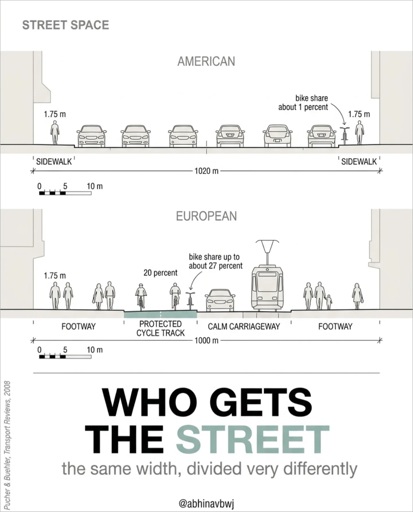
Architect and urban & computational designer Abhinav Bhardwaj made this great set of slides comparing urban design in the US and Europe, peppered with pithy observations like:
- European space is shaped on purpose: American open space is what’s left over.
- Small blocks make more corners, more routes, more street life.
- A fine grid offers hundreds of routes; the tree offers one way out.
Not here to defend North American urban planning, but these diagrams make absolutely no sense. Also, both Europe and the Americas are highly diverse and cannot be generalized so easily.
Yup, definitely dealt with a depressing amount of car-only infrastructure on my trip through eastern Europe, even in cities with trams in some spots. I’d call the European diagram in the link the “European ideal” that cities try to strive for, and that north / western European places with lots of money are more often able to achieve than elsewhere on the continent.
But still makes you think. Europeans live closer together, way less space, but still use less space-efficient layouts. Sure, mostly not on purpose, grown that way over centuries. While industry quarters are closer to the american layout, less nice to walk.