

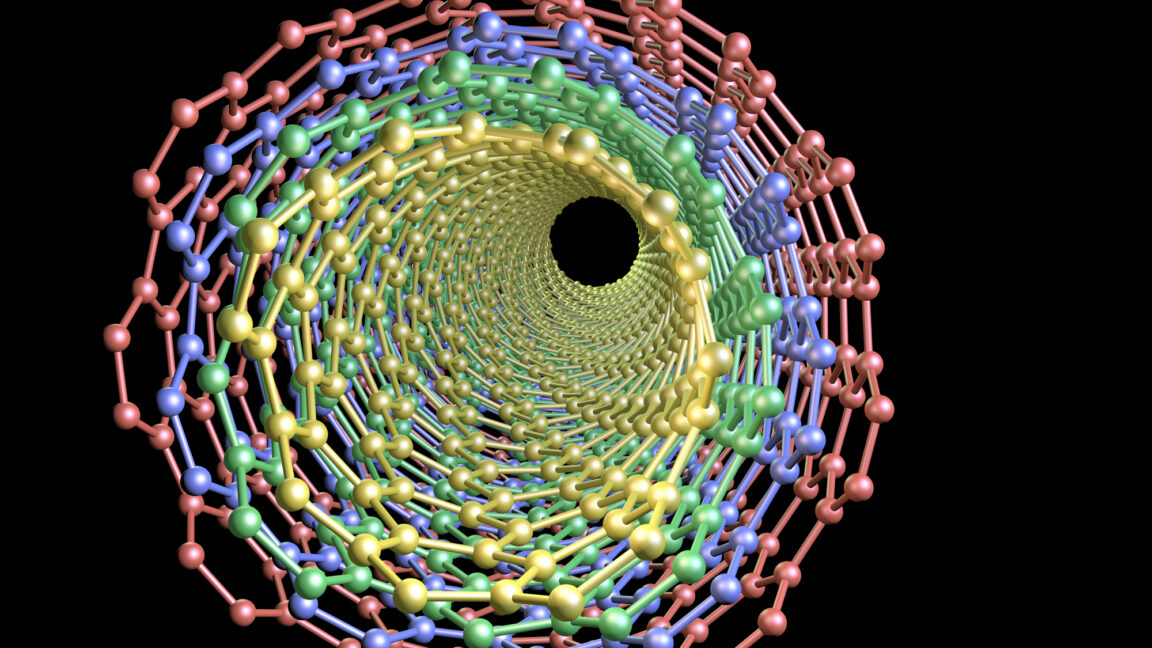
I wonder if anyone is working on making double-layered carbon nanotubes where the outer tube has a ringed structure like microtubules or nodes of ranvier to act like neurons. That’d be cool.
Is there actually any practical application if they do make such a thing?
Probably transfers electrons much more efficiently.
So useful for everything from high voltage power transfer to data cables.
They’re much lighter than traditional wire
to add to that lightness makes it a good candidate for using as overhead power lines in electric grids, currently they use aluminium instead of copper precisely because it is lighter so you need less pylons but the tradeoff is worse conductivity.
Yet all they must do to solve the issue is CONSTRUCT ADDITIONAL PYLONS.
I was under the impression that the problem with carbon nanotubes was actually structuring them on a wafer. If they can’t be reliably positioned and connected you get a lot of effectively random arcing. I’m sure doping is still useful, but I thought it wasn’t the core problem?
I’m biased as a structural biologist, but I’m pretty sure protein design approaches will eventually be used to facilitate proper placement. It’s not really high on my to-do list, so I suspect I’ll never get around to understanding the problem deeply enough to do it myself.
Good! It’ll be worth more when I tear it down and sell it to my local junkyard guy. /s